
You’ve sensed something was wrong before. And staying put worked.
In 2000, in 2008 and again in 2020, investors who felt uneasy and held on were eventually made whole. Each time, a rescue arrived: rates were cut, money was created, debt was added. Staying put felt like wisdom because the rescue always came.
That is exactly what makes this moment dangerous. Complacency isn’t ignorance. It’s a lesson learned from rescues, and every rescue was paid for by borrowing from a future that is now arriving. A downturn is weather; every portfolio should expect one. The harder question is whether the system that pays for the rescues can keep paying for them.
The questions are cheapest to ask when nobody wants to hear them.
Markets don’t only go up. A portfolio built as if they do is only half a portfolio.
The long-only assumption is so common that it rarely gets called an assumption. A portfolio that can only profit when prices rise is a complete tool in one kind of market and an incomplete one in another, and we do not get to choose which kind we are in.
Positioning on both sides, seeking gains when markets fall as well as when they rise, is a skill learned with real capital and real consequences. I spent ten years, 2008 to 2018, managing long and short positions in a private investment partnership. Sonrise portfolios carry that same two-sided toolkit, using no-load mutual funds held in your own account.
Every rescue borrows from the future.
Each major market rescue of the past quarter century, 2001, 2008 and 2020, was paid for with money created or borrowed, and each was larger than the one before it. Rescues buy stability today. The bill is deferred, not cancelled.
The rescues also lifted what people own more than what they earn. Since the end of 2008, the S&P 500 has risen more than eightfold while the typical worker’s inflation-adjusted weekly pay rose about 11%. Those who already held assets were carried; those who worked for wages mostly were not. That is not a forecast. It is the arithmetic of the last cycle, and it is why I keep asking who will pay the next bill, and with what.
The people paying the bill are disappearing.
Social Security is the clearest picture of the climate, because its arithmetic is published every year. Each pale figure below is a worker paying in. The gold figure is one person collecting.
Workers paying in for each person collectingDrawn to scale.
1940checks begin159195016.519605.119803.22025today2.62035projected2.32075projected1.92032Social Security retirement fund projected to run dry78¢of each promised dollar payable from taxes after that, unless Congress acts$40.3TU.S. public debt outstanding, October 20262026 Social Security Trustees Report: covered workers per beneficiary; 2035 and 2075 intermediate projections; retirement (OASI) trust fund reserves projected to be depleted in the fourth quarter of 2032, with about 78% of scheduled benefits payable. U.S. Treasury, Debt to the Penny, Oct. 6, 2026. Projections are the Trustees’, not Sonrise Opportunity’s.
When the people paying in can no longer cover the promises, there are three ways out that every government facing this arithmetic has had. And a fourth almost no one plans for:
Tax more.Take a larger share from fewer workers.Pay less.Break the promise to those collecting.Print.Keep the promise in dollars that buy less.Lose control.The rescue stops working, and prices fall instead.The first two are votes no one wants to cast. The third requires no vote at all. The fourth is not a choice. For more than twenty-five years, each crisis has been met with easier money and more debt. If the next rescue would take more inflation than the system can bear, the printing press stops being an exit, and what remains is deflation: asset prices falling toward what incomes can actually support.
I don’t predict when. My view today is that the fourth door, deflation, is the risk most portfolios are least prepared for. Sonrise portfolios are built to act on it, while keeping the ability to move in either direction if I am wrong.Complacency is the risk that never shows up on a statement.
Many of the investors hurt worst in 2008 were not reckless. They were comfortable. Complacency doesn’t feel like risk, which is exactly what makes it dangerous, and every rescue that worked made it feel a little safer.
Every position in every portfolio should be able to answer one question: why is this here, and what happens if I am wrong? When that question becomes awkward to ask, complacency has already set in.
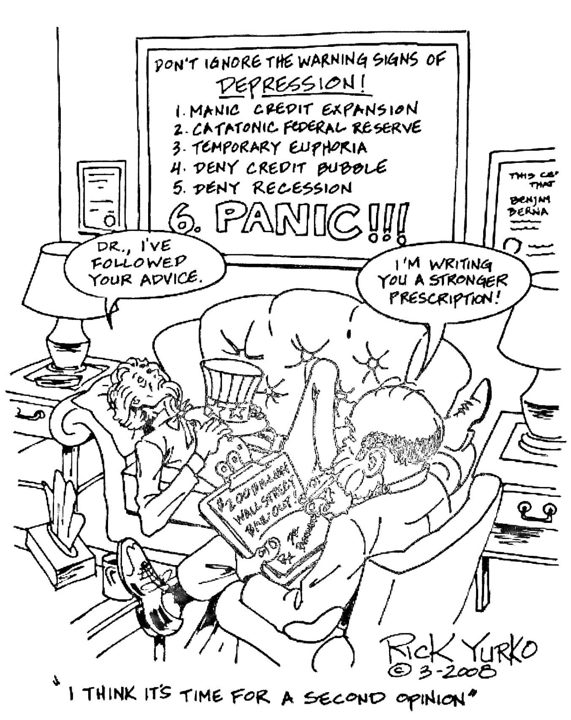
“I think it’s time for a second opinion.” Ran with my Seeking Alpha article “Warning Signs Of A Modern Depression: See 1990 Japan,” March 17, 2008. Historical commentary, shown as published; not a forecast or a recommendation.
Your return requirement is not your return desire.
A portfolio that can act on a falling market is not right for everyone, and it should not be. Before taking on any client, I ask three questions. The answers say more about the right portfolio than any questionnaire:
- What are you trying to protect?
- What return do you actually need, not want, but need?
- How would you genuinely respond if your portfolio fell sharply over a few months?
Plans quietly fail in the gap between the first two answers and an honest third one. Someone who would sell everything in a hard decline does not belong in a portfolio built for one, however much return they want. That is why Sonrise offers three portfolios with three disclosed risk ceilings, and why the more assertive ones are reserved for investors whose goals, experience and resources suit them. The choice starts with you, and it is made together.
Conflicts belong on the table, not in the fine print.
Sonrise Opportunity is a fee-based fiduciary. There is no product shelf, and the advisory fee does not change with the funds selected. Your assets are held at Charles Schwab in your own name, and you can see every position and every trade.
I am also a licensed insurance agent and may earn commissions if a client buys an insurance product I recommend. That is a conflict of interest, and you should know it before we start. It is disclosed in full in our Form ADV Part 2A, and any insurance recommendation must stand on its own merits and in your best interest.
The investor who survives the decline is the one who is there for the recovery.
Long-run returns are only available to investors who stay invested long enough to collect them. The arithmetic of losses is unforgiving:
−20% → +25%needed just to get back to even−33% → +50%needed just to get back to even−50% → +100%needed just to get back to evenPreserving capital in a downturn is not timidity. It is what keeps compounding possible. A portfolio built to survive what actually happens, not only what is hoped for, gives itself the best chance to grow over time.
Capital preservation in a downturn is not conservatism. It is the prerequisite for growth.
About this page. These are the views of David J. Roskoph, President of Sonrise Opportunity Corporation. They describe how he thinks about markets and risk; they are not a forecast of market or economic events and not a recommendation to buy or sell any security. Social Security and debt figures are published government statistics and projections, illustrated to scale; they are not returns of any portfolio. Loss-recovery figures are arithmetic illustrations. No strategy can guarantee gains or prevent losses.
A portfolio’s posture is chosen in calm skies, not in the storm.
Twenty minutes, in person in Richmond, by phone or by video. No cost and no obligation: a direct conversation about what you are trying to protect, and whether a portfolio that can act in either direction fits you.